
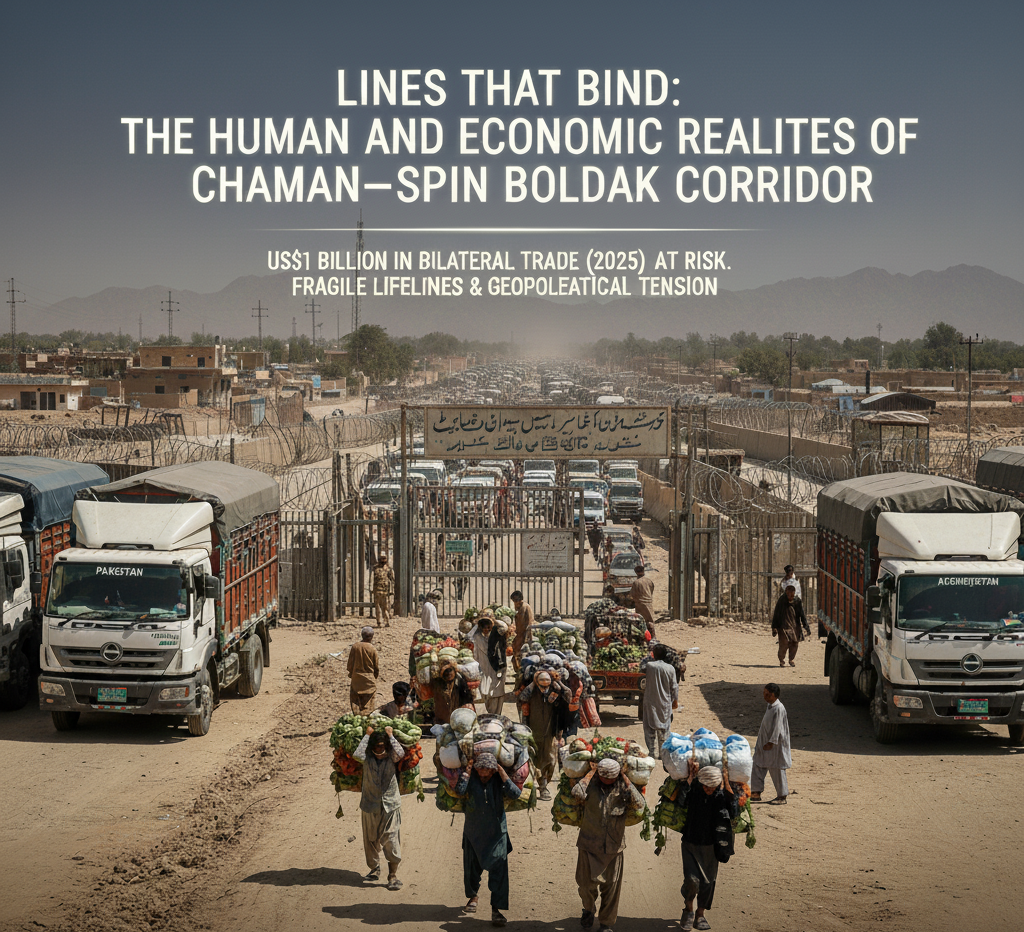
The Chaman–Spin Boldak corridor, straddling Pakistan and Afghanistan, stands at the heart of a
brittle yet vital economic lifeline. In the first half of 2025 alone, bilateral trade between Pakistan
and Afghanistan surpassed US$1 billion, with Afghanistan exporting $277 million and importing
$712 million. (Profit by Pakistan Today) This surge underscores not just macroeconomic ambition
but the deeply rooted dependence of border communities on this corridor for their daily survival.
Yet, this interdependence exists under the constant threat of geopolitical tension, as evidenced by
recurring border closures and security standoffs.
Recent escalations including direct clashes between Pakistani and Afghan forces have triggered
dramatic trade disruptions. In October 2025, all major crossings, including Chaman, were sealed
in response to military skirmishes. (The Express Tribune) This shutdown came with a steep
economic cost: Pakistan’s Federal Board of Revenue reported that with crossings like Chaman,
Torkham, and Ghulam Khan shut, the suspension of trade channels is depriving both sides of
critical fiscal flows. (The Express Tribune) For small traders, transporters, and laborers in the
borderlands, these are not abstract losses they translate into spoiled perishable goods, idled
vehicles, and evaporating livelihoods.
At a local level, the dependency on informal trade networks is deep rooted. Long-standing reports
and field interviews show that many individuals, especially “small laghris” (porters and low
volume transporters), operate through unofficial, community-based routes to carry goods across
the border. While quantifying informal smuggling precisely is difficult, the pervasiveness of
unregistered trade acts as a coping mechanism for those locked out of formal economic channels.
These networks not only generate income but also serve as social safety nets: they are embedded
within kinship ties, tribal affiliations, and generational business practices.
The policy tensions in this border economy are stark. On one hand, the Pakistani state emphasizes
security imperatives, and its authorities have increasingly restricted pedestrian and commercial
traffic citing security risks and cross-border violence. (Pajhwok Afghan News) On the other hand,
restrictive measures alienate the very communities whose economic livelihoods depend on cross
border trade. For them, the border is not merely a line on the map; it is a market, a labor pool, and
a source of intergenerational stability. The dissonance between national security logic and local
livelihood realities fosters a perennial legitimacy crisis.
The humanitarian dimension of trade disruption cannot be understated. Thousands of trucks remain
stranded on both sides of the frontier, imposing daily losses measured in millions. Local traders
and transporters report that goods spoil, costs mount, and in many cases, their meager capital is
eroded. Meanwhile, general consumer prices on both sides spike: according to reports, the closure
has already contributed to inflationary pressures in essential goods for border towns. (The
Economic Times) These economic shocks hit hardest on the most vulnerable micro-entrepreneurs,
informal workers, and low-income border families.
In search of pragmatic solutions, a balance must be struck that reconciles security with economic
and social imperatives. One promising approach is a registered trader-permit system: by
identifying and certifying frequent small traders, customs authorities can channel legitimate trade
through streamlined formal mechanisms. Complementing this, a community-monitoring
committee, involving local chambers, frontier forces, and civil society, could help legitimize trade
flows while ensuring transparency and reducing rent-seeking. Infrastructure investments including
cold-storage, inspection sheds, and separate lanes for low-volume traders would not only lower
transaction costs but also encourage formalization over time.
To sum it up, this border region must be reimagined not as a security liability but as a shared
economic space where border communities are active partners in trade governance. Rather than
reactive closures, a forward-looking policy framework should institutionalize cooperation,
digitalize customs processes, and embed local voices within governance structures. In doing so,
Pakistan and Afghanistan can preserve a fragile but essential economic ecosystem safeguarding
not only national interests but the dignity and livelihoods of communities that depend on the
Chaman–Spin Boldak corridor for survival.

Research Associate at CRPPSS and Graduate of Economics from BUITEMS, Winner of the Policy Hackathon.
Contact the author: khanist07@gmail.com

Welcome to CRPPSS, where expert financial solutions and precision meet. Trust us to navigate your finances to your growth.