
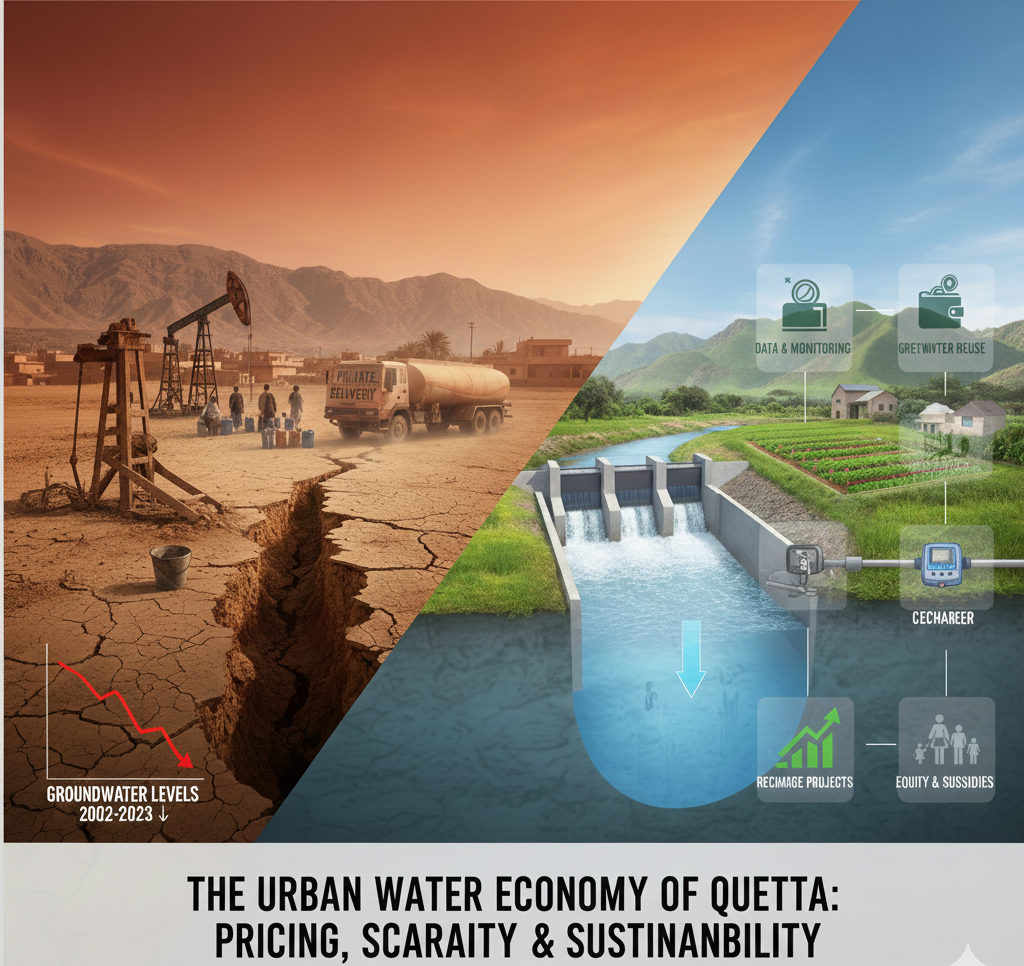
Quetta’s water crisis has deepened into a structural economic challenge. Satellite-based
hydrological studies show constant and severe declines in the valley’s groundwater levels from
2002 to 2023, with little natural recharge occurring in most locations. Land subsidence has been
recorded in parts of the city a visible sign that the aquifer is being physically damaged from over
extraction. These scientific findings match what residents experience daily: falling tube-well
yields, widespread tanker dependence, and declining water quality. The core issue is simple
demand exceeds the aquifer’s capacity, and current institutions are not designed for scarcity.
The economic roots of this crisis lie in the common-pool resource nature of groundwater. When
extraction is unregulated and unmetered, each individual has an incentive to pump as much as
possible before the water table sinks further a classic “tragedy of the commons.” The private
benefit of extraction is captured by the user, while the social cost future scarcity, rising pumping
costs, and loss of recharge potential is borne collectively. This misalignment of incentives results
in overuse, inefficiency, and inequity. The current tanker market has further deepened inequality:
those who can afford deliveries bypass shortages, while poorer households pay more per litre or
face long gaps in access.
This brings us to the sensitive question: Can water be priced and if so, how without causing public
outrage? The answer lies in admitting that pricing does not mean making water expensive for the
poor. Economic theory distinguishes between lifeline consumption (basic human needs) and
excess consumption (high-use households, commercial entities, tanker suppliers). The justification
is grounded in equity and efficiency: price signals should discourage wasteful extraction only
beyond essential needs. Many developing cities have successfully used increasing-block tariffs,
where the first block is free or heavily subsidized, ensuring the poor are protected, while higher
consumption is priced progressively to reflect scarcity. This ensures fairness while slowing
depletion.
But pricing alone is insufficient. Effective reform begins with information and governance: well
registration, minimal metering, and transparent groundwater monitoring. Without data, no pricing
or regulation can be credible. Once transparent information exists, policies such as limited
extraction permits for large commercial pump operators or tanker suppliers become feasible. These
approaches draw on Pigouvian principles the idea that users who impose higher social costs (e.g.,
excessive extraction) should internalize part of that cost. The revenues from such Supply-and-
Demand based pricing can be reinvested into recharge projects, leak reduction, and subsidies for
vulnerable households, creating a self-financing, socially protective system.
Supply-side and demand-side reforms must complement governance changes. Managed aquifer
recharge through check dams, infiltration basins, and stormwater capture provides long-term
replenishment at relatively low cost. Demand-management solutions water-efficient fixtures,
greywater reuse, drip irrigation for peri-urban farms reduce pressure on the aquifer. Economic
evaluations consistently show that these scattered, low-cost interventions offer better cost–benefit
ratios than large-scale engineering projects, particularly in arid regions like Balochistan where
additional surface water is limited.
The path forward for Quetta is therefore not a single policy but a portfolio: protect lifeline water,
send scarcity signals for high consumption, regulate large extractors, invest in recharge, and build
a transparent data system. The purpose of pricing is not to burden households it is to align private
incentives with the city’s long-term survival. Without these adjustments, continued over-extraction
risks irreversible aquifer collapse and ever-widening inequality. Managing water as both a human
right and an economic resource is the only sustainable path for Quetta’s future

Research Associate at CRPPSS and Graduate of Economics from BUITEMS, Winner of the Policy Hackathon.
Contact the author: khanist07@gmail.com

Welcome to CRPPSS, where expert financial solutions and precision meet. Trust us to navigate your finances to your growth.